By Edward Bolingbroke(Article available only to Bloomberg subscribers)Bloomberg features Eris Innovations’ latest funding round alongside the growing institutional adoption of Eris SOFR Swap futures.Read Bloomberg article
window.dataLayer = window.dataLayer || [];
function gtag(){dataLayer.push(arguments);}
gtag('js', new Date());
gtag('config', 'G-G640VE0Y19');
Leading trading firms invest in Eris Innovations amid growing demand for capital-efficient listed derivativesCHICAGO, IL — May 19, 2026 — Eris Innovations, an intellectual property licensing company and the creator of Eris SOFR Swap futures (Eris SOFR), today announced a new investment round backed by leading trading firms, following a marked rise in Eris SOFR activity at CME Group.Eris Innovations completed the investment round to support the launch of Eris Options in June, as well as the continued growth of the Eris SOFR complex, providing capital and strategic alignment with core liquidity providers. Participants include proprietary trading firms and their affiliates such as DRW, DV Trading, BlackEdge Capital, Arb Trading Group, Chicago Trading Company, and TransMarket Group, with DV Trading leading the round. CME Ventures also participated in the transaction.Recent activity in Eris SOFR reflects accelerating institutional adoption:Open interest tripled over a 16-month period from January 2025 to April 2026, increasing from 237,000 to a recent high of 713,000 contractsDuring the same period, the number of market participants more than doubled, according to CFTC public reports, reflecting expanding engagement from mortgage hedgers, regional banks, and asset managersAverage daily trading volume exceeded 22,000 contracts in the first quarter of 2026, including a monthly record of 44,863 contracts in MarchGrowing numbers of participants are accessing liquidity from both swap dealers and futures market makers to hedge interest rate risk using Eris SOFR, achieving initial margin savings of more than 60% compared with traditional OTC swapsEris Options are designed to deliver swaption-like risk exposure in a standardized, exchange-traded format. The product extends the capital efficiency and operational advantages of Eris SOFR into the options market, offering market participants a new way to manage longer-dated SOFR rate risk.“The rapid adoption of Eris SOFR demonstrates strong demand for liquid, capital-efficient, listed alternatives to OTC interest rate products,” said Michael Riddle, Chief Executive Officer of Eris Innovations. “This round aligns us with experienced liquidity providers critical to establishing deep, transparent markets for Eris Options.”“Eris SOFR Swap futures unlocked a more efficient way to access swap spread risk, combining the precision of OTC markets with the efficiency of listed derivatives,” said Don Wilson, CEO of DRW and co-inventor of the technology behind Eris Innovations. “The introduction of options extends that framework by offering more efficient ways of managing swap spread risk in the volatility space.”“Buy-side hedgers and fund managers are savvier than ever these days, constantly evaluating how to deploy their capital most efficiently to reach their investment objectives, lest they fall behind their competitors,” said Jared Vegosen, Co-Founder of DV Trading. “Having provided liquid markets in Eris SOFR since inception, we are focused on bringing the same depth, consistency, and pricing discipline to Eris Options at launch.”“SOFR underlies the vast majority of U.S. dollar floating-rate financing, and there is clear demand for more efficient tools to manage volatility in longer-dated exposures,” said Josh Mateffy, Founder and Managing Partner of BlackEdge Capital. “As a leading market maker in CME Group’s interest rate options for more than a decade, BlackEdge is well positioned to help build deep, consistent markets for Eris Options.”Eris Options will complement CME Group’s existing U.S. Treasury and SOFR complexes. Eris Options feature futures-style margining, similar to forward-premium OTC swaptions, and remove operational burdens associated with swap data repository (SDR) reporting, uncleared margin rules (UMR), and manual trade confirmations. About Eris InnovationsEris Innovations is an intellectual property licensing company that partners with global financial exchanges to develop futures products based on its patented product design, the Eris Methodology. Trademarks of Eris Innovations and/or its affiliates include Eris, Eris Innovations, Eris SOFR, Eris Options, and Eris Methodology. For more information on Eris Options, visit erisfutures.com/options. Media contact:Craig Haymakercraig.haymaker@erisfutures.com+1-952-952-6304Read more on Business Wire
window.dataLayer = window.dataLayer || [];
function gtag(){dataLayer.push(arguments);}
gtag('js', new Date());
gtag('config', 'G-G640VE0Y19');
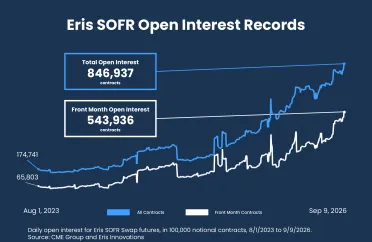
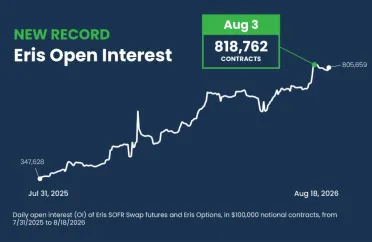
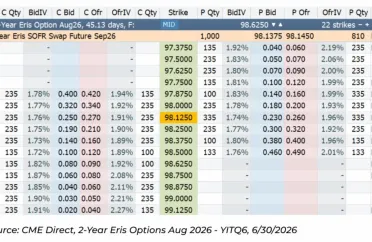
CME Group unveils Eris Options contract specificationsNote: Diagram depicts listing schedule for Eris Options, demonstrating how four monthly expiries deliver into underlying Eris SOFR Swap futures contracts over time. For example, top green box shows a July 2-year 93.000 Call (YITN6 C93000) being listed in March and physically delivering into the Sep 2-year Eris SOFR Swap future (YITU26) upon expiration in July.Following the recent press release announcing the June launch of Eris Options, CME Group released the Eris Options 2-page tearsheet, which includes detailed contract specificationsEris Options offer swaption-style risk in listed CME Group options, with four consecutive European-style monthly expiries (e.g., Jul, Aug, Sep, Oct) that physically deliver into 2-year, 5-year, or 10-year Eris SOFR Swap futuresEris Options feature futures-style margining, similar to forward-premium OTC swaptionsThey remove operational burdens associated with swap data repository (SDR) reporting, uncleared margin rules (UMR), and manual trade confirmationsFor more information, visit erisfutures.com/optionsNew Eris SOFR Market Maker: Bank of MontrealThe BMO swap desk is the most recent dealer to start responding to inquiries for Eris SOFR block trades“We are pleased to respond to the growing end user demand for Eris SOFR Swap futures by providing block trade liquidity across the swap curve,” said Akash Agrawal, Head of US Rates, Bank of MontrealFutures brokers can contact Akash Agrawal, Wesley Hyde, or Mike Novack on Bloomberg IB chat, and BMO clients can contact their BMO sales coverageClick here for a full list of Eris SOFR Block Market MakersOpen interest cracks 710,000 contractsEris SOFR Open interest (OI) reached 713K contracts ($71B notional) on Apr 28, finishing the month at 697K contractsOI in Eris SOFR Swap futures tripled over a 16-month period from January 2025 to April 2026, increasing from 242,000 to the recent high of 713,000 contractsOI leapt 158% year-over-year (YoY), up 427K contracts ($42.7B notional) from April 2025Mega blocks boosted OI including three Apr 17 trades, each greater than 7,500 contracts ($750mm notional)April activity follows record Q1 daily volume of 22,000 contracts, and record March daily volume of 44,000 contractsNew CME Group article: Unlocking Capital with Eris SOFREric Leininger of CME Research and New Product Development released a new article on reducing capital with Eris SOFR Swap futuresIt begins, “In the current landscape of shifting interest rate cycles and tightening liquidity, institutional hedgers are facing a silent drain on their balance sheets: initial margin (IM).”It notes, “the era of set-and-forget OTC hedging is over. As capital costs remain elevated, the ability to reduce margin …by 60% is a competitive necessity.”For similar risk transfer, insurers, banks, and asset managers achieve more capital flexibility with less balance sheet dragExplore initial margin comparisons between Eris SOFR and cleared OTC swaps at erisfutures.com/marginsavings
window.dataLayer = window.dataLayer || [];
function gtag(){dataLayer.push(arguments);}
gtag('js', new Date());
gtag('config', 'G-G640VE0Y19');
CME Group, the world's leading derivatives marketplace, today announced it will launch options on Eris SOFR Swap futures on June 15, 2026, pending regulatory review.
In the current landscape of shifting interest rate cycles and tightening liquidity, institutional hedgers are facing a silent drain on their balance sheets: initial margin (IM). While the transition from LIBOR to SOFR is behind us, participants continue to seek efficiencies in their hedging strategies within SOFR instruments.
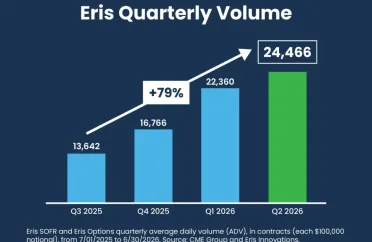
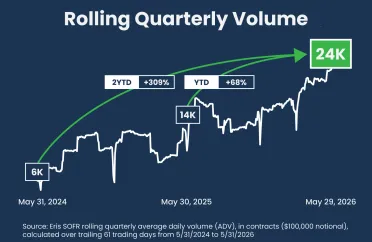
Quarterly ADV for Q1 2026 climbed to 22,360 contracts ($2.2B notional), up 33% from Q4 2025. Eris SOFR also set a monthly volume record in March with 44,863 ADV, up 30% from the previous record from December 2025
The following are four approaches one can take to efficiently hedge the price risk of holding residential mortgage loans prior to bulk sale, improving execution and profitability. Not surprisingly, they intersect and are progressively more robust.Method 1. Forward SalesThe first method is to sell the loans forward, similar to what occurs in the Agency To-Be-Announced (TBA) market, where TBAs are sold today and eligible loans are delivered during the settlement window in the future. Although there is some forward selling occurring in the Non-QM market, capital markets professionals are not observing meaningful price improvement and find it having limited use. The process is also bi-lateral, lacking uniformity and liquidity. However, it is an option, and it does transfer all risk - but at the expense of potential price improvements from hedging the interest rate risk and seeking better execution through bulk sales.Method 2. Correlated HedgesThe second approach is a data-based regression method, involving the selling (short selling) of US Treasuries, or paying fixed on SOFR swaps, as these are both correlated with the price of loans. However, regression analysis requires good quality loan price data to analyze against US Treasury or SOFR swap prices. While the US Treasury and SOFR swap markets are both liquid and transparent, offering accurate and available data, this is not the case for Non-QM loan data. Challenges include:Data Quality: Due to the shortage of accurate and uniform baseline Non-QM loan price data, regression results can have limited use.Theory Flaws: Co-linearity, for example the correlation of 10-year rates with other tenor rates (e.g. 2, 4, 5 and 7-year rates), may erroneously suggest a hedge instrument that does not match the expected maturity of the loans being hedged.Practicality: Co-linearity may also recommend impractical hedges, such as a butterfly strategy of short 3-year, long 5-year, and short 10-year SOFR swaps to hedge a loan pool that would be more accurately hedged by shorting all 3 of these maturities.Method 3. Hedging to Expected Prepayments (CPRs)The third method involves hedges that match the expected prepayment schedule of the loan pool. This effectively hedges the funding interest rate risk that would be required to hold the loans to final maturity. Conditional Prepayment Rates (CPRs), widely used to explain borrower prepayment behavior, can inform us of the outstanding unpaid principal balance (UPB) of a loan pool, and hedges are then established to best align with this profile.Hedge Example: A Non-QM loan pool with an average market-neutral coupon may have an 18% CPR, implying a weighted average life of 4.5–5.5 years. One approach might be to hedge to the expected 5-year average life, shorting the 5Y Eris SOFR Swap futures contract. However, the loan pool is not a bullet repayment loan; it prepays steadily over time. Therefore, a more accurate approach would be to utilize a combination of 2, 5, 7 and 10-year Eris SOFR Swap futures to hedge the funding interest rate risk more precisely with the expected prepayment schedule.Method 4. Hedging to a Stochastic Model PriceThe fourth and most robust, but more complex approach to pricing and hedging Non-QM loans is to use a stochastic, discounted cash flow (DCF) model. Stochastic is a fancy word used in probability modeling, meaning that interest rates will move in a random manner over time according to a probability distribution implied by market traded volatility, rather than following the risk-free (i.e.hedgeable) future path of rates. The model determines expected future cash flows based on probabilities of prepayment, and then discounts the expected cash flows to today.In evaluating the financial instruments on which to build this model, one quickly will find that it is not possible to trade future primary mortgage rates to inform us of future borrower prepayment behavior. Therefore, models are based on SOFR swaps, the most efficient way to model, trade and hedge the future path of interest rates. Once the future path of SOFR rates is determined, a mortgage-SOFR spread is added to model the future path of mortgage rates and therefore borrower behavior.The Case for SOFR Swaps vs. US TreasuriesFinancial modelers prefer using SOFR swaps to build their models because they are liquid, easily accessible, and efficient to trade. Critics may ask: "Why not use US Treasuries?" The reason is twofold. First, it is inefficient to trade forward expectations of US Treasury rates as there is no efficient market in term financing of US Treasuries beyond a few months. This is necessary to price and hedge forward US Treasury rates. This is the balance sheet effect, with US Treasury securities requiring the financing of the full purchase price, while SOFR swaps are derivatives, requiring only the financing of initial margin. Second, credit idiosyncrasies of US Treasuries muddy the water when one is hedging forward mortgage rates. Therefore SOFR swaps, liquid and easily accessible as Eris SOFR Swap futures, are favored in running models and trading SOFR swap hedges.ConclusionsAll methods outlined above intersect. However, the limited availability of Non-QM loan price data means that determining hedges by regression of poor quality Non-QM loan price data with high quality US Treasury or SOFR swap data, can yield inaccurate hedges. Consequently, replicating the prepayment profile of loan pools with more precise Eris SOFR Swap futures hedges - Method 3 - or the use of a robust stochastic model based on SOFR swaps - Method 4 - are today’s favored approaches to hedging Non-QM and improving execution and profitability.To learn more about hedging Non-QM with Eris SOFR, contact John.Douglas@erisfutures.com.
window.dataLayer = window.dataLayer || [];
function gtag(){dataLayer.push(arguments);}
gtag('js', new Date());
gtag('config', 'G-G640VE0Y19');
Open interest (OI) increased to 592,848 contracts, up 19% YTD (+94,469 contracts / $9.5B notional) since year-end. Eris/Treasury Swap Spreads (ETSS) aided OI growth with at least 25K contracts ($2.5B notional) traded in each of the 5-year and 10-year ETSS in February.
New indices mark the first time an index provider brings futures-based indices to market using CME Group's Eris interest-rate swap futures